Light roast espresso is harder than dark roast espresso, and most of the advice on the internet still assumes a dark roast: 18 grams in, 36 grams out, 25 to 30 seconds, 9 bar. Follow that with a light Nordic roast and you get a sour, thin shot and the conclusion that light roasts are not for espresso. They are. They just need more water, more heat, more rest and, often, less pressure. This guide covers why, what to change, and the recipes we use for our own coffees.
Light roast espresso at a glance
| Rest after roast | At least 2 weeks, better 3 to 5; light roasts release CO2 more slowly than dark roasts |
|---|---|
| Dose | What your basket is rated for, typically 18 g in an 18 g basket; 15 g for turbo shots |
| Ratio | Start at 1:2.5 (18 g in, 45 g out); 1:3 for clarity, 1:2 only for milk drinks |
| Temperature | 93 to 96 °C; start at 93 to 94 and go up if the shot is sour |
| Time | 25 to 35 seconds for a classic shot; 10 to 20 seconds for a turbo shot |
| Pressure | 9 bar works; 6 bar with a coarser grind is often better for light roasts |
| Pre-infusion | 5 to 10 seconds at low pressure before full pressure |
| Target | 20 to 23 percent extraction, 7 to 10 percent TDS; in practice, sweet and juicy with no sharp edge |
Why light roasts behave differently
Three things change when a coffee is roasted light instead of dark, and all three work against a standard espresso recipe.
The bean is denser and less soluble. Roasting breaks down cell walls and converts sugars and fibre into soluble material. A light roast stops that process earlier, so the bean is harder, the grinder has to work more, and hot water pulls flavour out of it more slowly. The same grind, time and temperature that fully extract a dark roast leave a light roast under-extracted, which tastes sour, thin and salty rather than sweet.
It holds its carbon dioxide longer. Roasting fills the bean with CO2. Research from the Zurich University of Applied Sciences, led by Samo Smrke and Chahan Yeretzian, found that dark roasts release more CO2 and release it faster, while light roasts give it up slowly over weeks. In the portafilter, trapped gas pushes back against the water, opens channels through the puck and makes shot after shot behave differently. That is why a light roast pulled three days after roasting gushes, chokes and tastes sour in no particular order, and the same bag three weeks later behaves.
There is less to hide behind. Dark roast espresso is forgiving because roast flavour, body and bitterness fill the cup whatever the extraction. A light roast is mostly acidity, sweetness and aromatics, so an under-extracted shot has nothing to cover the sourness, and a channelled shot shows every flaw.
Rest: the variable most people skip
If you change one thing, change this. Fresh light roast is not a flex, it is a handicap. Most guides suggest 10 to 21 days of rest for light roast espresso, roughly twice what a dark roast needs, and in our experience the window keeps opening after that. Scott Rao has noted that four-week-old beans extracted higher than fresher ones in his own tests. Our Gesha and SL09 are at their most even for espresso from about week three to week six after the roast date printed on the bag.
Resting does not mean leaving the bag open. Keep the beans in the sealed valve bag at room temperature, away from the oven and the window. If you will not finish a bag within six weeks, portion it into small airtight containers and freeze them; take out one dose at a time and grind from frozen or after a few minutes on the counter. More on timing in how long light roast coffee lasts.
Ratio: give the coffee more water
The espresso brewing ratio is the weight of liquid in the cup divided by the weight of dry coffee. The Italian default is around 1:2. For light roasts, start at 1:2.5 and do not be afraid of 1:3.
The reason is arithmetic. Rao's rule of thumb is that the ratio roughly equals extraction yield divided by strength (TDS). A 1:2 shot at a healthy 20 percent extraction is 10 percent TDS, which is intense and syrupy, and with a light roast it is hard to reach 20 percent at 1:2 at all. Stretch to 1:2.5 and the same 20 percent extraction lands at about 8 percent TDS: still espresso, but with the acidity and sweetness in balance. His example for a light Geisha is a 1:3 shot at about 22 percent extraction and 7.3 percent TDS, which he describes as trading body for clarity. His test is simple: set the grinder one small notch coarser, pull 18 grams in and 54 out in 30 to 35 seconds, and compare it with your usual 1:2. Most people find the longer shot juicier, less sharp and less sour.
The exception is milk. In a cappuccino or flat white, a 1:3 light roast shot disappears. Pull 1:2 to 1:2.2 with a full dose and accept a little more sourness in the naked shot, because the milk will round it off.
Temperature: hotter than you were taught
Dense, lightly roasted coffee needs more heat to extract. Most light roast guides put the brew temperature between 93 and 96 °C, against 88 to 92 for dark roasts. Start at 93 to 94. If the shot is sour and the grind and ratio are already where you want them, go up a degree at a time. If a coffee tastes harsh or astringent at a high temperature, the problem is usually channelling or a roast defect, not the heat itself, and Rao's advice for that case is to lower the temperature and extraction a little rather than fight it.
On a machine without temperature control, a long flush to bring the group up to heat, or simply brewing from a freshly heated boiler, does most of the work.
Grind: finer, but aim for time, not a number
Light roasts usually need a finer grind than a medium roast on the same machine, because the harder bean resists extraction. But the target is a shot time, not a grinder setting. For a classic shot, aim for 25 to 35 seconds including pre-infusion, and move the grinder until you land there. Rao's rule is to avoid going over 35 seconds whatever the shot size, and to grind slightly coarser than the setting that gives the very highest extraction, because the finest workable grind compresses the puck and channels.
Two grinder notes. First, light roasts punish inconsistent grinders more than dark roasts do, because fines and boulders in the same dose extract at different rates and the coffee has no roast flavour to cover it. A single-dosing grinder with decent burrs matters more than a pressure-profiling machine. Second, big flat burrs produce fewer fines than conical burrs; fines help the puck resist water, so with a flat-burr grinder you may find yourself grinding finer or dosing slightly higher than a conical-burr recipe suggests.
Pressure and flow: the case for 6 bar
Nine bar was standardised for darker Italian roasts. Rao calls constant nine-bar pressure a poor fit for light roasts, which generally taste better at faster flow and higher extraction. If your machine lets you adjust pressure, try 6 bar. If it does not, a longer pre-infusion and a slightly coarser grind get you some of the way.
The clearest version of this idea is the turbo shot, popularised by Lance Hedrick around 2021 and built on Rao's extraction work and a 2020 study in the journal Matter by Christopher Hendon and colleagues, which found that extraction peaks at a medium-coarse grind and that lower doses ground coarser gave more reproducible shots. The recipe: 15 grams in, 45 grams out, 10 to 20 seconds, 5 to 6 bar, grind coarser than normal espresso. The result is a sweeter, cleaner, more transparent shot with less body, and it suits light roasts particularly well. It is also easier to dial in on a cheap machine than a classic shot, because the coarser grind and lower pressure channel less.
At the other end, Rao's blooming espresso on the Decent machine, a 30-second low-pressure soak followed by a slow pour, pushed light roasts up to 29 percent extraction at 1:2.5. You do not need that machine to use the idea: a long, gentle pre-infusion before full pressure is the single most effective anti-channelling tool on any machine that offers one.
Puck preparation
With light roasts, most shots that taste bitter or harsh are not over-extracted, they are channelled: water found a path of least resistance and over-extracted a small part of the puck while under-extracting the rest. Rao's line is that you have probably never had a truly over-extracted espresso. So before you change the recipe, fix the puck.
- Distribute. A needle tool (WDT) stirred through the grounds breaks clumps and levels the bed. It makes more difference with light roasts than any gadget that follows.
- Tamp level, not hard. Pressure beyond firm does nothing; an uneven tamp does damage.
- Use the right basket. Dose to the basket's rating. Over-dosing a basket with a light roast leaves no headspace for the puck to swell, and the shot chokes.
- Watch the first drops. If they appear in one spot or spray, the puck is channelling. A bottomless portafilter shows this; a spouted one hides it.
Water
Espresso is 90 percent water, and light roasts show water faults more than dark roasts. Rao's roastery water is 45 ppm general hardness and 45 ppm alkalinity; he suggests 30 to 50 ppm alkalinity and 30 to 100 ppm hardness as a working range. Very soft water tastes sour and flat, very hard water dulls acidity and scales the boiler. If your tap water is far outside that range, a filter jug with remineralisation or a bottled brewing water makes a bigger difference than any recipe change.
Dialling in: a short procedure
- Rest the coffee at least two weeks. Three is better.
- Dose to the basket rating. Distribute, tamp level.
- Set 94 °C, pre-infusion on if you have it, and a 1:2.5 ratio.
- Adjust grind until the shot runs 25 to 35 seconds.
- Taste. Sour or thin: finer first, then a degree hotter, then stretch to 1:3. Bitter or drying: check the puck for channelling first, then coarser, then a degree cooler.
- Once it tastes right, change nothing but the grind for the rest of the bag. Day-to-day drift is the coffee resting, not the recipe failing.
Troubleshooting
| Symptom | Likely cause | Fix |
|---|---|---|
| Sour, thin, salty | Under-extraction | Finer grind, higher temperature, longer ratio |
| Bitter, drying, hollow | Channelling, or over-extraction of part of the puck | Fix distribution and tamp; then coarser or cooler |
| Shot gushes in 15 seconds | Too coarse, or too fresh | Finer; rest the beans longer |
| Shot chokes, drips | Too fine, over-dosed, or puck swelling from CO2 | Coarser; dose to basket; rest longer |
| Same recipe, different shot every time | CO2 from fresh beans, inconsistent grind or prep | Rest two to three weeks; WDT; single-dose by weight |
| Tastes great black, vanishes in milk | Ratio too long for milk | Pull 1:2 with full dose for milk drinks |
Our coffees as espresso
Everything we roast is roasted for filter first, lighter than a dedicated espresso roast, and all three coffees work as espresso with the adjustments above. Starting points, all with at least three weeks of rest:
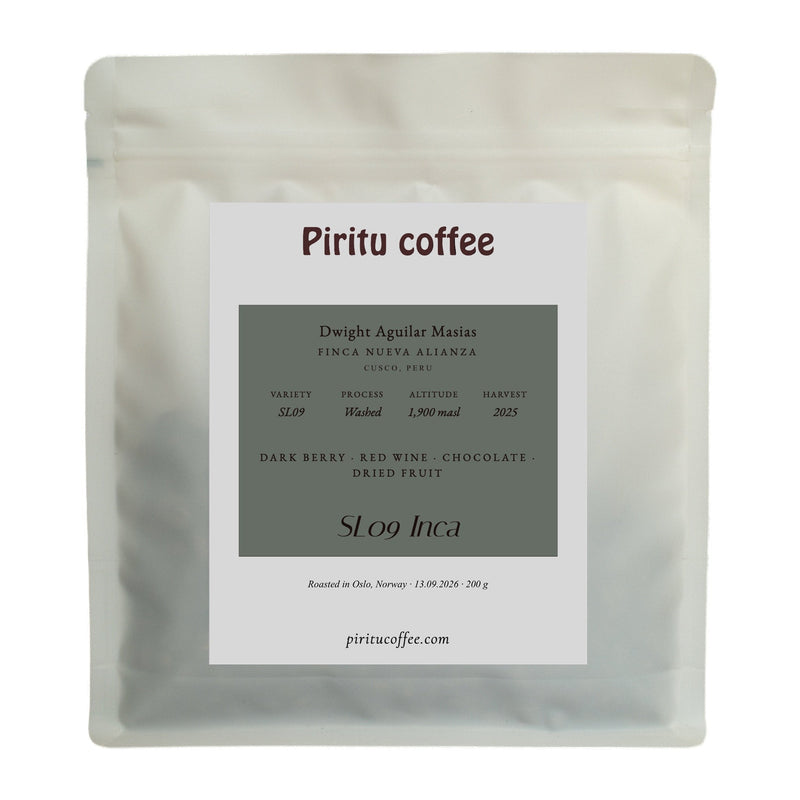
- SL09 Inca. 18 g in, 45 g out, 93 °C, 28 to 32 seconds. The 60-hour fermentation gives it dark berry, red wine and chocolate that hold up under pressure, and it is the one of our three that works best in milk at 1:2. Read more in the SL09 guide.
- Red Gesha. 18 g in, 50 g out, 94 °C, 28 to 32 seconds, or a turbo shot at 15 g in, 45 g out, 6 bar. Jasmine, lychee and honey; drink it black.
- Yellow Gesha. Same as the Red, a degree hotter if it reads sour. This is the coffee to try the 1:3 experiment on. What Gesha is and why it behaves this way is in What Is Gesha Coffee? The Complete Guide.
If you brew filter as well, the V60 guide covers the same coffees at 91 to 92 °C.
Frequently asked questions
Can you use light roast coffee for espresso?
Yes. Light roasts need a finer grind, a longer ratio (1:2.5 to 1:3), a higher temperature (93 to 96 °C) and more rest after roasting than dark roasts, and they are less forgiving of channelling. With those changes they make sweet, clear, fruit-forward espresso.
What temperature is best for light roast espresso?
Between 93 and 96 °C. Start at 93 to 94 and raise it a degree at a time if the shot tastes sour once grind and ratio are set. Dark roasts are usually brewed cooler, around 88 to 92 °C.
What ratio should I use for light roast espresso?
Start at 1:2.5, for example 18 grams of coffee to 45 grams of espresso, and go to 1:3 if the shot is still sour or sharp. Use 1:2 only for milk drinks, where a longer shot gets lost.
How long should light roast coffee rest before espresso?
At least two weeks, and most light roasts are better at three to five weeks. Light roasts release carbon dioxide more slowly than dark roasts, and the gas causes channelling and unpredictable shots when the coffee is too fresh.
Why does my light roast espresso taste sour?
It is under-extracted. Grind finer, raise the temperature, lengthen the ratio, and make sure the beans have rested at least two weeks. If the shot runs fast and uneven, fix puck preparation before changing anything else.
What is a turbo shot?
A fast, low-pressure espresso popularised by Lance Hedrick around 2021: about 15 grams in, 45 grams out, 10 to 20 seconds, 5 to 6 bar, with a coarser grind than a classic shot. It gives a sweeter, cleaner, lighter-bodied cup and suits light roasts well.
Is 9 bar too much pressure for light roasts?
Not necessarily, but lower pressure often works better. Light roasts tend to taste best at faster flow and higher extraction, and 6 bar with a coarser grind reduces channelling. If your machine is fixed at 9 bar, use pre-infusion and a longer ratio instead.
Do I need an expensive machine for light roast espresso?
No. A consistent grinder, rested beans, careful puck preparation and a scale matter more than the machine. Pre-infusion and adjustable pressure help, but a basic machine with a good grinder will pull a good light roast shot, especially as a turbo shot.
Sources
- Scott Rao, The 2:1 Ratio (2017): brewing ratio arithmetic, the 1:3 test and the argument that most 1:2 shots are under-extracted.
- Scott Rao, How to Approach Brewing Different Coffees (2024): dose to basket, 35-second ceiling, higher flow for very light roasts, water targets.
- Scott Rao, My Two-Week Espresso Education on the Road (2023): flow, pressure, blooming espresso, flat versus conical burrs.
- M. I. Cameron, C. H. Hendon et al., Systematically Improving Espresso, Matter, 2020: extraction peaks at a medium-coarse grind; lower doses ground coarser are more reproducible.
- S. Smrke, C. Yeretzian et al., Time-resolved gravimetric method to assess degassing of roasted coffee, Journal of Agricultural and Food Chemistry, 2018: CO2 release by roast degree and its role in extraction and crema.
- Caffeine and Photos, Turbo Shot Espresso: Hedrick's recipe and its origins.
- Simon and Bearns, Coffee degassing: how long to rest filter coffee and espresso: rest-time ranges by roast level.
Written by Giovanni Lindblom, co-founder of Piritu Coffee. We roast Gesha and SL09 from Cusco in Oslo, for filter first and espresso second, and drink most of it as espresso anyway.