Spell the word. Geisha or Gesha?
If you said Geisha, you have Panama on the brain. If you said Gesha, you’ve been reading World Coffee Research. Or maybe talking to producers in Ethiopia, Colombia, Peru.
It is not a typo. The two spellings tell you almost everything about where the world’s most coveted coffee variety has been, and where it is going next.
Both Start in the Same Ethiopian Forest
Long before Panama, there was a village called Gesha in southwestern Ethiopia. In the 1930s, British researchers collected wild coffee samples from the surrounding forests. Among them was a tall, gangly plant with elongated cherries and a startling cup profile. Jasmine. Bergamot. Tropical fruit. Tea.
The variety travelled to research stations in Tanzania and Costa Rica before agronomist Don Pachi Serracín brought seedlings to Panama in 1963. There it remained quiet for forty years. Most farms found it too low-yielding and too fragile to bother with.
Then in 2004, Hacienda La Esmeralda entered something called Geisha into the Best of Panama auction. It sold for $21 per pound. The next year, $50. By 2019, certain Esmeralda lots traded above $1,000 per pound. Today, peak Panama Geisha auction lots exceed $10,000 per kilo.
The legend was set. The spelling, Geisha, became the brand.
The Spelling Question
Here is the catch. The Ethiopian village is Gesha. The Amharic transliteration uses no “i”. Researchers spell it Gesha. The Specialty Coffee Association documentation now uses Gesha. World Coffee Research uses Gesha.
So why does the world say Geisha?
Panama got there first commercially. When La Esmeralda printed labels for that record-breaking 2004 auction, the spelling was Geisha. Probably a transliteration drift that nodded toward the more familiar Japanese word. The spelling stuck because the prices stuck. Geisha became synonymous with rarity, with auction theater, with the kind of coffee that only collectors and competition baristas can justify buying.
Producers outside Panama have increasingly pushed back. When you see Gesha on a label today, it usually signals one of three things. The producer values etymological accuracy. The coffee is not from Panama. Or the producer wants to differentiate from the Panama price structure.
Peru, in our case, is all three.
How Peru Built Its Specialty Story
Specialty coffee in Peru is a recent phenomenon. The country has long produced coffee. It is one of the largest exporters by volume. But for decades, most of it was commodity-grade, sold cheap, blended into supermarket brands no one remembered the name of.
That changed in the 2010s. A new generation of Peruvian producers started experimenting with Gesha, SL09, and other high-end varieties. They learned washed and natural processing. They invested in solar dryers and fermentation tanks. They started entering competitions.
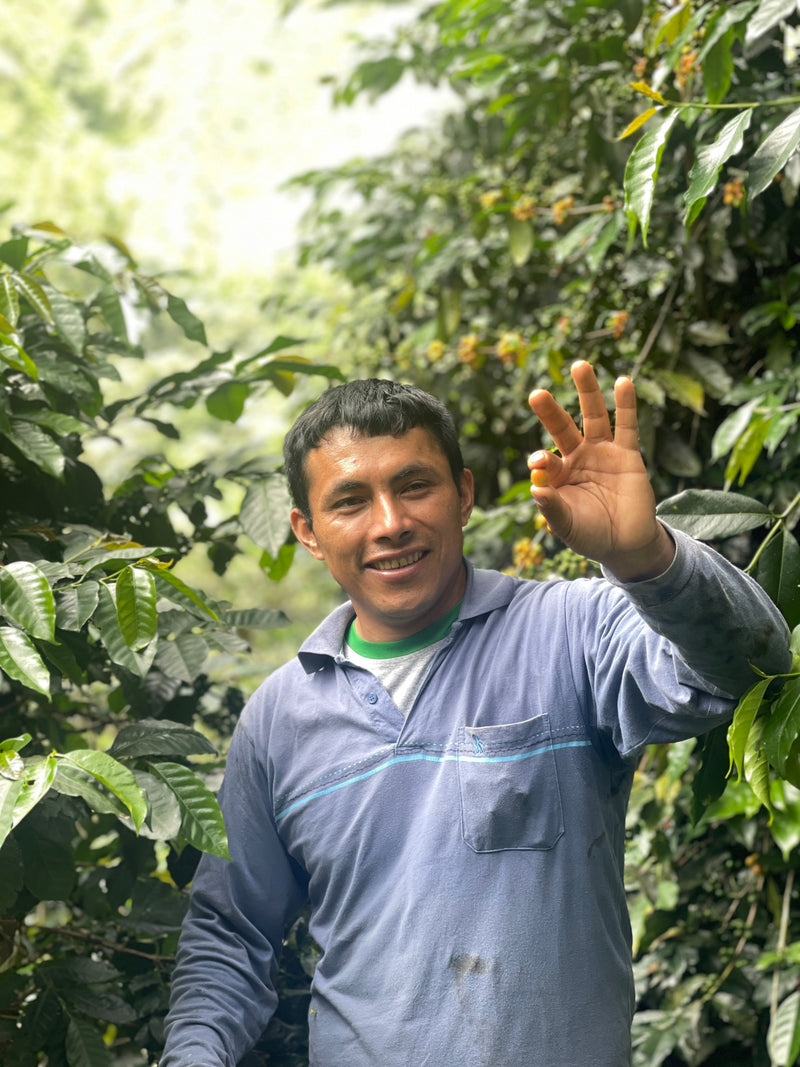
Peru hosted its first Cup of Excellence in 2017. The following year, Dwight Aguilar Masías, the producer behind our Gesha, took first place with a score above 90. In 2021 he did it again, becoming the first Peruvian producer to win twice. By 2023, Cup of Excellence winners from Peru were trading at $130+ per pound. Still a fraction of Panama’s prices, but commanding real respect across the specialty world.
The Cusco region, with its high altitude, sandy mountain soils, and the microclimates of La Convención, turned out to be exceptional terroir for Gesha. The variety thrived at 1,800 to 2,000 meters. Producers began producing lots with cupping scores rivaling Panama’s mid-tier offerings.
This is where our current coffees come from.
Side by Side
| Panama Geisha | Peru Gesha | |
|---|---|---|
| Region | Boquete, Volcán | Cusco, La Convención |
| Altitude | 1,500-2,000m | 1,800-2,000m |
| Best cupping scores | 92-96+ | 89-93 |
| Auction prices (per kg) | $200 to $10,000+ | $50 to $300 |
| Retail price (200g) | $65-250+ | $20-50 |
| Availability | Allocated, often pre-sold | Growing, more accessible |
| Flavor profile | Jasmine, bergamot, tropical fruit, tea | Floral, stone fruit, citrus, honey |
| Industry maturity | 20+ years | 10+ years |
| Brand recognition | Iconic | Emerging |
The cupping differences are subtle. Panama Geisha at its peak has a more intense, gem-like clarity. The jasmine is dialed to maximum. The bergamot is unmistakable. Peru Gesha trades some of that ceiling for a warmer, more rounded profile. Stone fruit comes forward. Honey notes are common. Citrus is bright but less ethereal.
For most drinkers, blind tasted, they cannot reliably distinguish a $200 Panama Geisha from a $50 Peru Gesha.
For the small minority, competition baristas, judges, very experienced cuppers, the Panama lots still have a unique signature. The question is whether that signature is worth a 4 to 10x premium.
Why the Price Gap Exists
Three reasons explain why Panama commands the premium, and none of them are about quality differences large enough to justify the gap.
The first is first-mover brand equity. Panama created the Geisha market. La Esmeralda is a household name in specialty coffee. Auction prices have a self-reinforcing effect, since high prices signal scarcity which justifies higher prices.
The second is limited production. Panama is a small country. The microclimates suitable for high-grade Geisha are limited. Production is capped.
The third is auction theater. Specialty buyers from Asia, Europe, and the Middle East compete fiercely in the Best of Panama auction. Coffee buying becomes a status purchase, much like wine.
These are market dynamics, not the bean.
What This Means for the Drinker
If you are new to Gesha, here is an honest framework.
Buy Panama Geisha when:
- You want the canonical Gesha experience
- You are cupping competitively or professionally
- You can afford $65+ for 200g and want to taste what auction-grade coffee feels like
Buy Peru Gesha when:
- You want most of the Panama Geisha experience at a quarter to a third of the price
- You drink Gesha regularly enough that price actually matters
- You value supporting an emerging specialty origin
- You believe, as we do, that the future of premium specialty coffee will look more like Peru than Panama. Rigorous and transparent, but accessible to actual coffee drinkers rather than collectors.
At Piritu Coffee, we made the bet on Peru. We import small lots from Cusco, roast them in Oslo, and ship them within 24 hours of roasting. Our current lots are grown by Peru’s first two-time Cup of Excellence winner, whose Geisha Amarilla placed 5th in Cup of Excellence Peru 2025 with a score of 89.86. That was the farm’s competition lot, sold at auction; ours is the same farm and the same harvest, not the auction lot. The prices reflect what the coffee costs to source and roast, not auction speculation.
A Note on Processing
Both Panama and Peru produce Gesha in multiple processing styles.
Washed coffee gives the clean, articulate, classic Gesha profile. Natural processing adds heavier body and intensifies tropical fruit notes. Honey-processed sits between washed and natural, balancing clarity and sweetness. Anaerobic and experimental processing is high-risk, high-reward, and often divisive.
Our current Peru Geshas are washed, which shows the clarity of the variety well in filter brewing.
The Long View
The Panama Geisha story is largely written. Prices will continue to rise at the top end. Allocation will tighten. The brand will only grow.
The Peru Gesha story is being written right now. Each harvest brings new producers, new processing experiments, new lots scoring higher than last year. Peru is not waiting to be discovered. Cup of Excellence juries already score Peruvian lots above 90. Our own producer has won the competition twice. What has not caught up yet is the price.
The window to drink Peru Gesha at today’s prices is finite.
Frequently Asked Questions
Is Peru Gesha as good as Panama Geisha?
For most drinkers in most contexts, yes. The most expensive Panama auction lots remain in a price class of their own, but Peru Gesha competes with mid-to-upper-tier Panama Geisha at a fraction of the price.
Why is it spelled differently?
Both are the same variety from Ethiopia. Geisha is the Panama-popularized spelling. Gesha is the etymologically correct spelling used by World Coffee Research and most non-Panama producers.
How should I brew Peru Gesha?
We recommend pour-over with a V60 or Kalita Wave. Use 14 g of coffee to 250 g of water at 91°C. Aim for a 2:30 to 3:00 brew time. The floral notes need clean filtration.
Where can I buy Peru Gesha?
You can order our Cusco-sourced Yellow Gesha and Red Gesha directly from us. We ship within 24 hours of roasting, with Posten across Europe and DHL Express worldwide.
Why is Panama Geisha so expensive?
Three reasons. Limited production, first-mover brand equity, and auction-driven price discovery dominated by collectors rather than drinkers.
Does Peru produce other rare coffee varieties?
Yes. Our SL09 Inca is a good example. A forgotten Kenyan selection variety grown at 1,900m in Santa Teresa, with dark berry, red wine, and chocolate notes.
Try Peru Gesha for Yourself
The best argument for Peru Gesha is not an article. It is a cup.
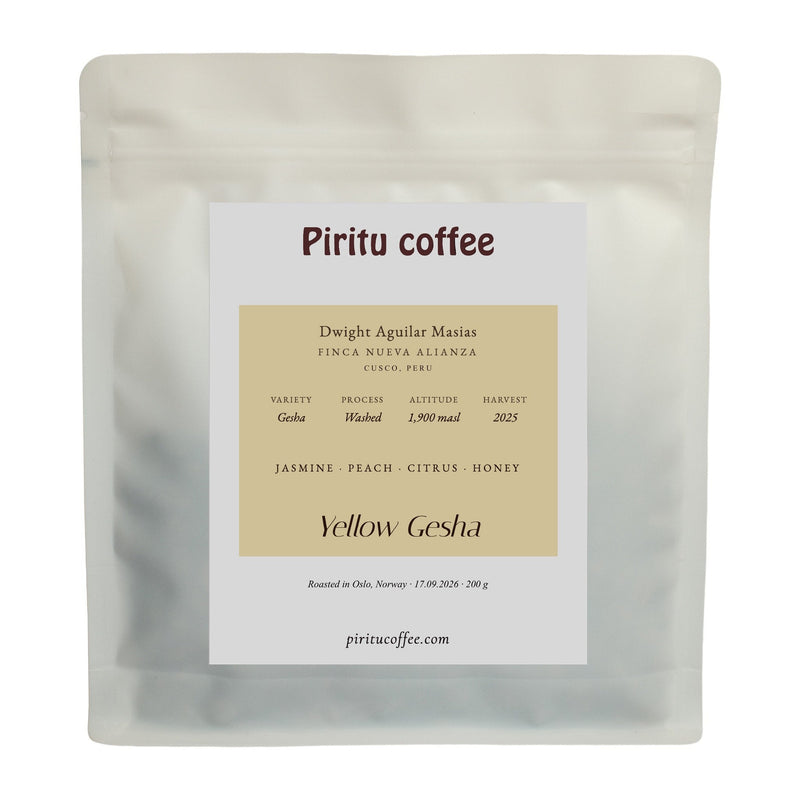
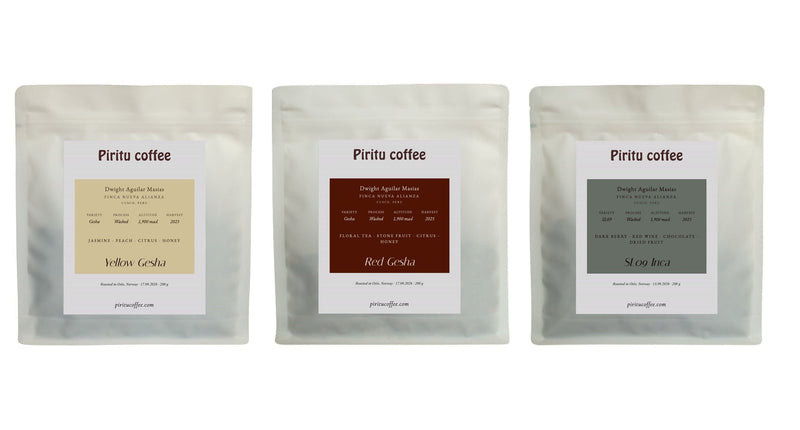
- Yellow Gesha (200g). From the farm whose Geisha Amarilla placed 5th at Cup of Excellence Peru 2025. Floral, jasmine, peach, citrus, honey.
- Red Gesha (200g). Tropical fruit, stone fruit, citrus, honey.
- SL09 Inca (200g). A bonus, if you are curious about Peru’s other rare varieties.
For brewing guidance, reach us at hello@piritucoffee.com. Happy to recommend recipes based on your equipment.
Read more about our sourcing in Cusco and our philosophy.