Gesha is the most coveted coffee variety in the world. It has won more competitions, broken more auction records, and inspired more obsession among specialty coffee drinkers than any other coffee since coffee began being judged competitively.
It is also one of the most misunderstood.
What follows is a working guide to what Gesha actually is, where it comes from, what it tastes like, why it costs what it costs, and how to drink it well.
The Quick Answer
Gesha (sometimes spelled Geisha) is a coffee variety originally from the Gesha forest in southwestern Ethiopia. It produces beans with a cup profile unlike almost any other coffee. Floral, tea-like, citric, with notes of jasmine and bergamot. Today it grows in small quantities across Central and South America, and at its peak it commands the highest auction prices in the global coffee market.
That is the short version. The long version is more interesting.
Where Gesha Came From
In the 1930s, British researchers were combing the forests of southwestern Ethiopia for coffee plants that might resist disease and improve yields. Coffee is, after all, native to Ethiopia. Hundreds of wild varieties grow there.
Among the samples they collected was one from the area around a village called Gesha. The plants were tall, gangly, with elongated leaves and unusually large cherries.
The samples travelled through research stations. Kenya in 1936. Tanzania in 1938. Costa Rica’s CATIE research center in 1953.
At CATIE, the variety received an accession number, T2722, and was distributed to other Central American countries as a potential rust-resistant cultivar.
For decades, almost no one planted it. The yield was low. The plants were fragile. Farmers preferred Caturra and Bourbon.
In 1963, Panamanian agronomist Don Pachi Serracín brought seedlings to Panama. They were planted on a few farms in Boquete and Volcán. They sat there, quietly, for forty years.
Then in 2004, something changed.
The 2004 Moment
Hacienda La Esmeralda, a coffee farm in Boquete, Panama, entered a small lot into the Best of Panama auction. The label said Geisha.
The coffee scored 95, at the time one of the highest scores ever recorded. It sold for $21 per pound. The next year, similar lots sold for $50. The year after, $130. By 2019, Esmeralda’s flagship Geisha lots traded for over $1,000 per pound at auction. Today, peak Panama Geisha auction prices exceed $10,000 per kilo.
The specialty coffee world had its first true cult variety.
What Gesha Tastes Like
Most coffee tastes like coffee. Gesha tastes like something else entirely.
The classic Gesha cup profile includes:
- Jasmine. The dominant floral note, often described as perfume-like.
- Bergamot. The citrus oil used in Earl Grey tea.
- Tropical fruit. Mango, passionfruit, papaya.
- Stone fruit. Peach, apricot.
- Citrus. Lemon zest, orange blossom.
- Tea-like body. Light, clean, ethereal rather than heavy.
Cupped well, a great Gesha does not taste like coffee with floral notes added. It tastes like a floral drink that happens to be made from coffee beans. That is why baristas use it for competitions. Judges can identify Gesha blind almost every time.
Intensity varies by origin, altitude, and processing. Panama Geisha at peak quality has the most dialed-up jasmine and bergamot. Peru Gesha tends to be warmer, with more stone fruit and honey. Colombian Gesha can lean toward citrus-forward profiles.
Why Gesha Is So Special
Three factors converge to make Gesha exceptional.
The first is genetics. Gesha’s chemical composition is unusual. It has higher concentrations of certain volatile aromatic compounds, particularly geraniol and linalool, that contribute to floral notes. Most other coffee varieties do not produce these compounds in the same quantities.
The second is terroir sensitivity. Gesha expresses itself dramatically based on where it is grown. The same genetic material produces wildly different cups in Boquete (Panama) versus Cusco (Peru) versus Huila (Colombia). Few coffee varieties are this responsive to environment.
The third is processing potential. Gesha rewards careful processing. Washed Gesha is articulate and clean. Naturally processed Gesha is dense with fermented fruit notes. Honey-processed Gesha sits between. Anaerobic Gesha can be wild and divisive. The variety gives processors a wide canvas to work on.
The Spelling: Gesha vs Geisha
You will see both spellings on coffee labels. They refer to the same variety.
- Gesha is the etymologically correct spelling, matching the Amharic transliteration of the Ethiopian village name. Used by World Coffee Research, the Specialty Coffee Association, and most non-Panama producers.
- Geisha is the Panama-popularized spelling, dating from the 2004 La Esmeralda auction labels. Now strongly associated with Panama and the premium auction market.
If you see Geisha on a label, the coffee is almost certainly Panamanian or marketed in the Panama tradition. If you see Gesha, it is likely from Colombia, Peru, Costa Rica, or another emerging origin.
We cover the spelling history in depth in our Panama Geisha vs Peru Gesha guide.
How Gesha Is Grown
Gesha is not an easy crop.
The plants grow tall and lanky, with widely spaced branches. They are vulnerable to wind. They yield far less coffee per hectare than commodity varieties like Caturra or Catuai. Farmers who plant Gesha sacrifice volume for quality.
The variety performs best at high altitudes, typically 1,600 to 2,000 meters above sea level. Higher altitudes mean slower cherry maturation, which means denser beans with more complex sugars. Most premium Gesha is grown above 1,700m.
Optimal growing conditions include volcanic or mineral-rich soil, consistent rainfall of 1,500 to 2,500mm annually, cool temperatures averaging 18 to 22°C, shade cover from native trees, and cloud-forest microclimates.
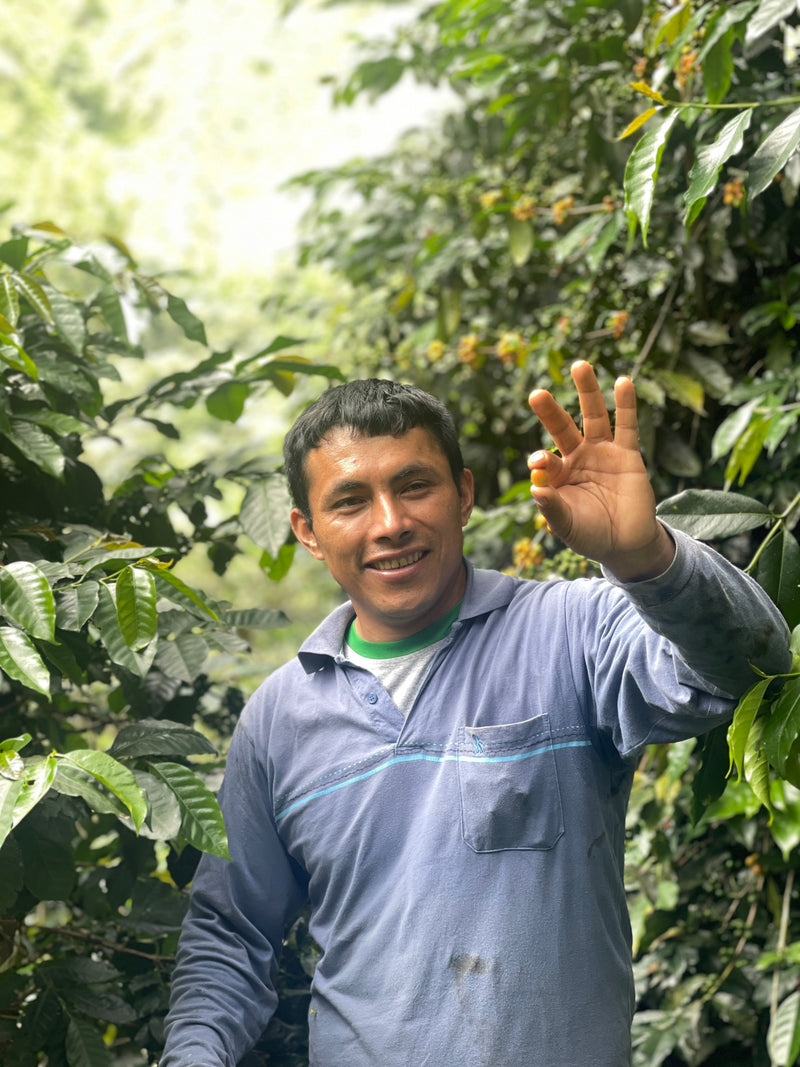
Santa Teresa in La Convención, Cusco, Peru, where our current coffees are sourced, meets all of these conditions at 1,900 meters. The Boquete region in Panama meets them at 1,500 to 1,800 meters. Specific microclimates in Colombia, Costa Rica, and Honduras also work.
Processing Methods
How Gesha is processed after harvest dramatically affects its cup profile.
Washed is the most common method for premium Gesha. The cherry pulp is removed, and beans are fermented in water tanks before drying. This produces the cleanest, most articulate expression of Gesha, with jasmine, bergamot, and tea notes coming through with clarity. Most competition-grade Gesha is washed.
Natural processing dries the cherries whole, with the fruit still on the bean. This adds heavier body and intensifies tropical fruit notes. Natural Gesha can be spectacular but is harder to execute consistently.
Honey-processed means the cherry skin is removed but some of the mucilage (the sweet sticky layer) is left on the bean during drying. Honey-processed Gesha balances clarity and sweetness.
Anaerobic and experimental processing uses oxygen-free fermentation, often with controlled microorganisms. Results vary wildly. Some are revelatory. Many are divisive. Stick with experienced producers.
How to Brew Gesha
Gesha’s floral notes are delicate. Brewing methods that highlight them include:
Pour-over (V60, Kalita Wave, Origami) is the gold standard. Clean filtration removes oils that muddy the floral notes.
Recipe for V60:
- 14g coffee, ground medium-fine
- 250g water at 91°C
- Bloom: 45g water, 30 to 40 seconds
- Pour in slow concentric circles
- Total brew time: 2:30 to 3:00
Cold brew works well for naturals, less so for washed Gesha. The cold extraction loses some of the floral aromatics.
Espresso works too, but the intensity and concentration changes the profile. Many espresso bars charge $15-25 for a single shot of Panama Geisha. Worth experiencing once.
Aeropress is surprisingly good with Gesha. The pressure extraction brings out more body without losing clarity.
Avoid drip machines, French press for filter Gesha (oils muddy the cup), and Moka pots.
Is Gesha Worth the Price?
Panama Geisha at retail typically costs $65-250+ per 200g bag. Peru Gesha, like ours, ranges from $20-50 per 200g. Colombian Gesha falls between.
For competition baristas and dedicated cuppers, the highest-tier Panama lots are worth experiencing at least once. The flavor concentration at that level is genuinely unique.
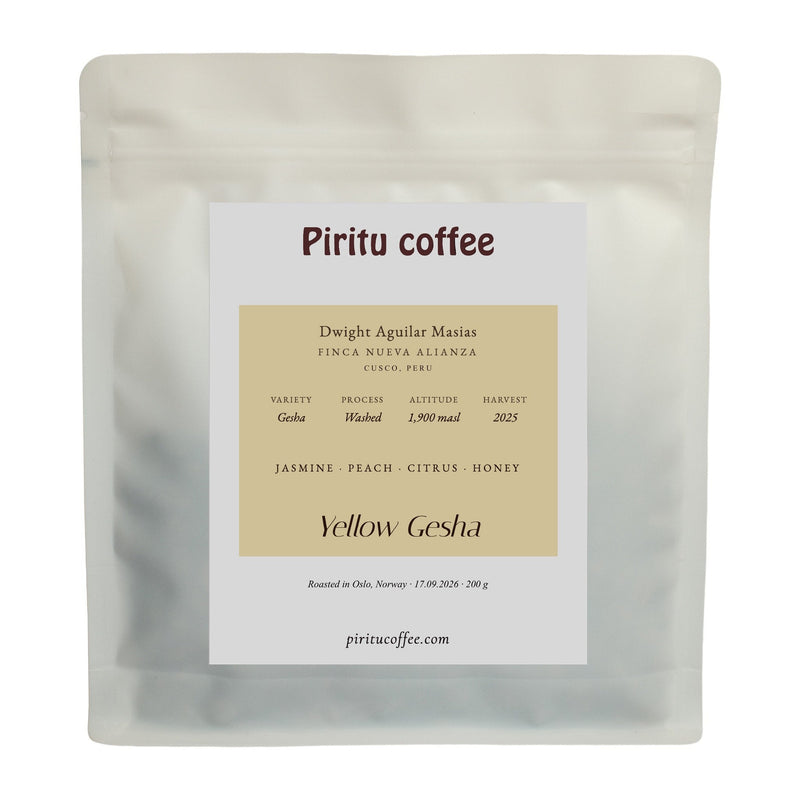
For most coffee drinkers, even serious specialty drinkers, mid-tier Gesha from Peru, Colombia, or Costa Rica offers most of the experience at a fraction of the price. Our Yellow Gesha comes from the farm of Peru’s first two-time Cup of Excellence winner, whose yellow Gesha lot placed 5th in Cup of Excellence Peru 2025 with 89.86 points.
An honest pricing framework:
- Under $40/200g. Accessible specialty Gesha, great value.
- $40-80/200g. Competitive-grade Gesha from established origins.
- $80-250/200g. Top-tier Panama or limited-release lots.
- $250+/200g. Auction-grade Panama, collector territory.
Frequently Asked Questions
What does Gesha taste like?
Gesha is known for jasmine, bergamot, tropical fruit, stone fruit, and tea-like body. It is more floral and tea-like than typical coffee.
Is Gesha and Geisha the same coffee?
Yes. They are the same coffee variety from Ethiopia. Geisha is the Panama spelling. Gesha is the etymologically correct spelling used elsewhere.
Where is the best Gesha grown?
Panama produces the most highly regarded Gesha at auction, particularly from Boquete and Volcán. Peru (Cusco), Colombia (Huila, Nariño), and Costa Rica also produce excellent Gesha at more accessible prices.
Why is Gesha so expensive?
Three reasons. Low yields per hectare, limited growing regions, and auction-driven price discovery (especially for Panama lots).
How should I brew Gesha?
Pour-over (V60 or Kalita Wave) is the standard. Use 14 g of coffee to 250 g of water at 91°C, with a 2:30 to 3:00 brew time.
Can I make espresso with Gesha?
Yes, but the high concentration changes the profile. Most specialty bars reserve Gesha for filter brewing where the floral notes are clearest.
Is Gesha the same as Geisha tea?
No. There is no relationship to Japanese geishas or to tea. The name comes from the Gesha village in Ethiopia. The spelling drift toward Geisha was a transliteration accident in Panama.
Does Gesha get its name from the Ethiopian village?
Yes. The variety was collected from forests near the Gesha (sometimes spelled Gecha) village in the Bench Maji Zone of southwestern Ethiopia in the 1930s.
Where to Buy Gesha
For Peruvian Gesha, sourced directly from Cusco, roasted in small batches in Oslo, and shipped within 24 hours of roasting:
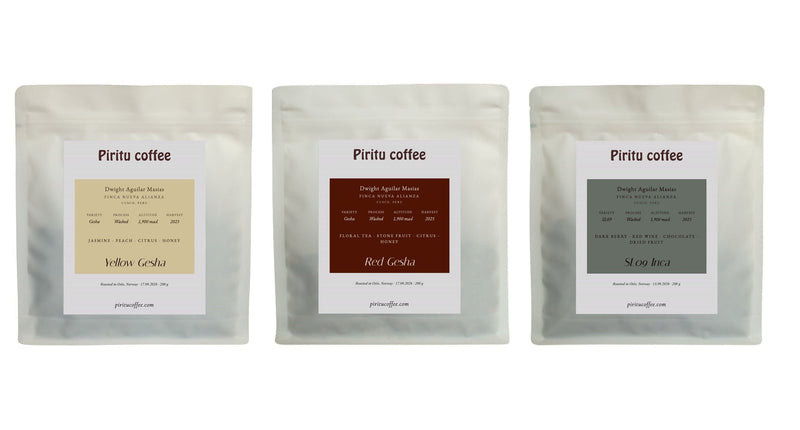
- Yellow Gesha (200g). From the farm whose yellow Gesha placed 5th in Cup of Excellence Peru 2025. Floral, jasmine, peach, citrus, honey.
- Red Gesha (200g). Tropical fruit, stone fruit, citrus, honey.
- SL09 Inca (200g). Not Gesha, but worth trying if you are exploring rare Peruvian varieties.
For brewing guidance, reach us at hello@piritucoffee.com.
For deeper reading on the Gesha story:
- Panama Geisha vs Peru Gesha: Why the Spelling Tells You Everything
- About our sourcing in Cusco
- Our philosophy
Written by Giovanni Lindblom, co-founder of Piritu Coffee. We source rare Peruvian Gesha and SL09 microlots from Santa Teresa in Cusco and roast them in Oslo.