If you spend enough time around specialty coffee, three words keep coming up: Cup of Excellence. Roasters put it on their bags. Producers build their reputations on it. Auction prices connected to it make headlines far outside the coffee world.
But what actually is it? Who judges it, what does a score of 90 points really mean, and why should you care when you are simply choosing your next bag of coffee?
This is the complete guide, including the story of how a two-time Peru Cup of Excellence winner's Gesha ended up on our roaster in Oslo.
What Is Cup of Excellence?
Cup of Excellence, often shortened to CoE, is a competition and auction program that identifies the best coffees produced in a country in a given harvest year. It began in Brazil in 1999 and is run by the Alliance for Coffee Excellence, a nonprofit organization.
The idea was radical at the time: instead of coffee being sold as an anonymous commodity, individual farmers could submit small lots, have them judged blind by professional tasters, and sell the winning coffees at an online auction where roasters around the world bid directly.
Today, Cup of Excellence runs national competitions across Latin America, Africa, and Asia. Winning, or even placing, can change a farmer's life. It is often described as the Olympics of coffee, and for once the comparison is fair.
How the Judging Works
What separates Cup of Excellence from marketing awards is the brutality of its process. A coffee cannot buy its way in. It has to survive round after round of blind cupping.
The process looks roughly like this. Farmers submit samples from a single lot, and every sample is coded and anonymized. A national jury of trained cuppers tastes each coffee multiple times across several rounds, and any coffee that falls below the quality threshold is eliminated. The surviving coffees then go to an international jury, experienced professionals flown in from around the world, who cup every lot again, blind. Only coffees scoring 87 points or higher earn the Cup of Excellence title, and coffees scoring 90 or above receive the Presidential Award, the competition's highest distinction.
By the time a coffee wins, it has been tasted well over a hundred times by dozens of independent palates. There is no other quality signal in coffee that comes close.
Why Cup of Excellence Changed Coffee
Before CoE, even an exceptional farmer usually sold their harvest into the same blended, commodity-priced stream as everyone else. Quality was invisible, so there was little financial reason to pursue it.
Cup of Excellence made quality visible and paid for it. Winning lots are sold at global online auctions where the price is set by open bidding, and top lots routinely sell for many multiples of the commodity price. The 2021 Peru auction alone brought in over 35,000 US dollars for the country's top coffees.
That money does more than reward one farmer. It signals to an entire region that meticulous picking, careful fermentation, and patient drying are worth the effort. Many of the world's most celebrated coffee regions today were put on the map by a single Cup of Excellence result.
Peru and the Cup of Excellence
Peru joined the Cup of Excellence program in 2017, later than icons like Panama or Colombia, and it arrived with something to prove. Peruvian coffee had long been treated as a bulk origin, good for blends, rarely named on a bag.
The competition changed that quickly. Cusco, and in particular the province of La Convencion, emerged as one of the strongest regions in the country. High altitude, old soils, and a generation of producers willing to experiment with prized varieties like Gesha turned Peru into one of the most exciting origins in specialty coffee, and the auction results started reflecting it.
If you have read our guide on why Peru spells it Gesha rather than Geisha, you already know this story is bigger than one farm. But one farm does stand out.
Dwight Aguilar Masias, the First Two-Time Winner
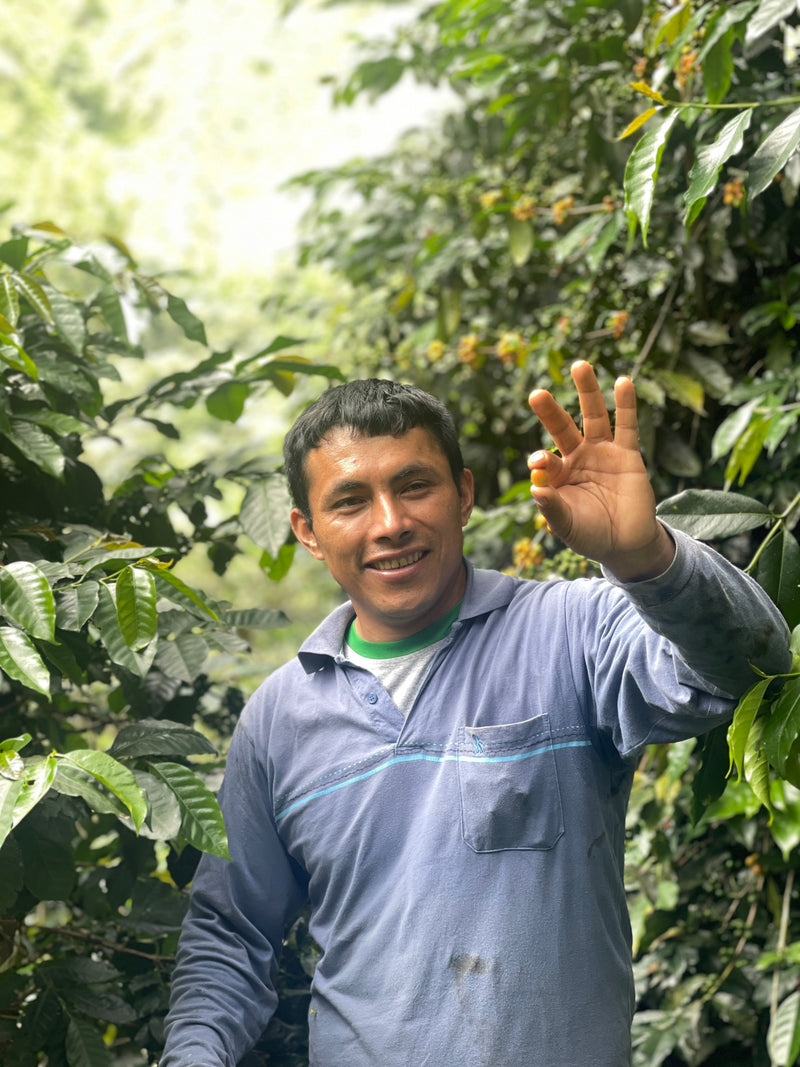
In 2018, a young producer named Dwight Aguilar Masias from Finca Nueva Alianza in Santa Teresa, La Convencion, won the Peru Cup of Excellence.
In 2021, he did it again. His washed Gesha scored 90.2 points, earning the Presidential Award and making him the first producer ever to win the Peru Cup of Excellence twice. Coverage at the time noted that no producer worldwide had achieved two national first places in the competition's history.
What makes his coffee remarkable is not luck. Nueva Alianza sits at 1,900 meters above sea level on the high slopes of the Andes, and Dwight's process is obsessive: cherries hand-picked at peak ripeness, rested in cherry for 24 hours, floated to remove defects, dry-fermented for 36 hours, then dried slowly on raised beds for around 20 days. Every step exists to protect the delicate florals that make a great Gesha taste like nothing else in coffee.
From Nueva Alianza to Oslo
This is where our story joins his.
When we started Piritu, we knew we did not want to launch with safe, forgettable coffee. We wanted lots that could stand next to anything being roasted in Europe. That search led us straight to Cusco, and to Dwight.
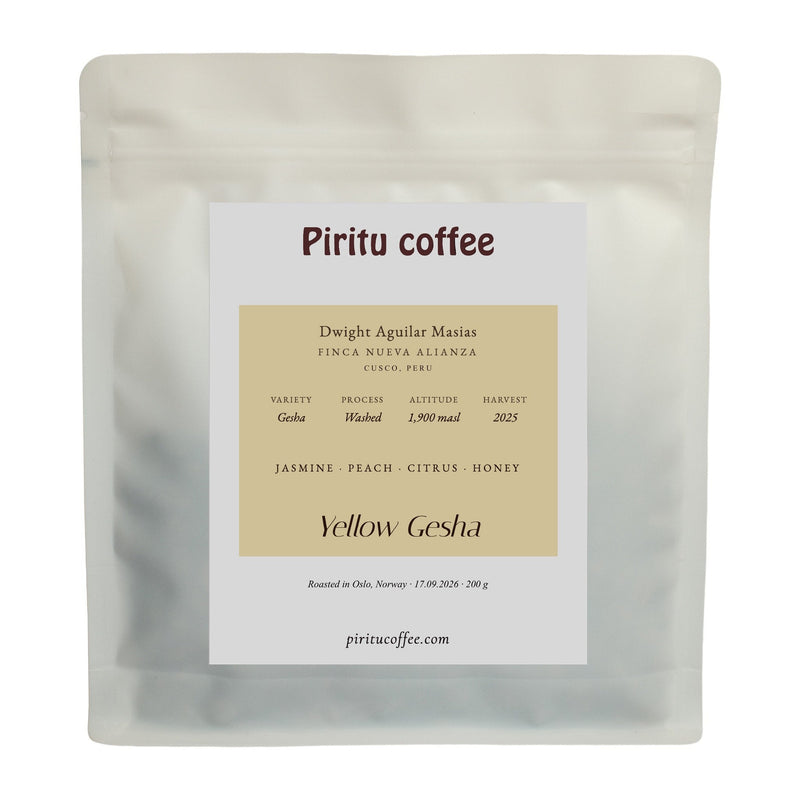
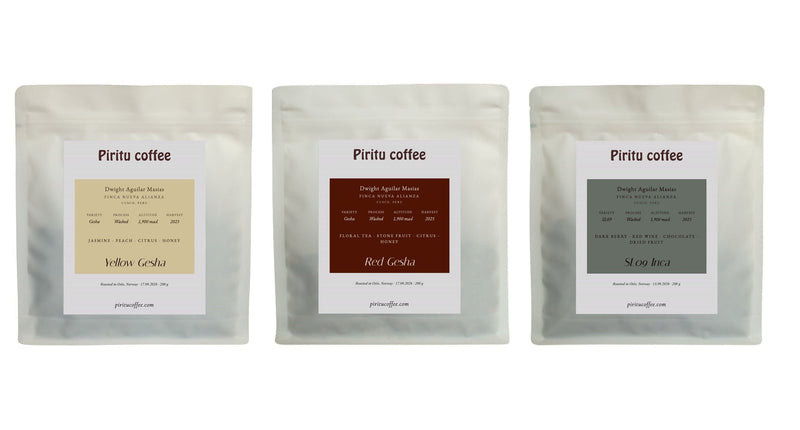
Our Red Gesha and Yellow Gesha both come from his farm, Finca Nueva Alianza, the same producer, the same slopes, and the same meticulous washed process that won Peru's Cup of Excellence twice. We roast them in small batches in Oslo, light enough that the florals survive, developed enough that the sweetness carries.
In the cup, the Red Gesha shows jasmine, lychee, and honeydew with bright citrus and a long honeyed finish. These are not everyday coffees, and that is the point. They are a chance to taste, at home, the level of quality that international juries score above 90 points.
Where to Start
If you are new to competition-level coffee, start with a simple pour over, use good water, and give the cup a minute to cool. The florals in a Gesha open up as the temperature drops, and the difference from a standard specialty coffee is not subtle.
Our current microlots from Finca Nueva Alianza are roasted in Oslo in small batches and tend to sell out between drops. You can find them, along with our SL09 from Cusco, in the shop.
Cup of Excellence exists to answer one question: how good can coffee actually be? Thanks to producers like Dwight Aguilar Masias, we get to pass that answer on to you.