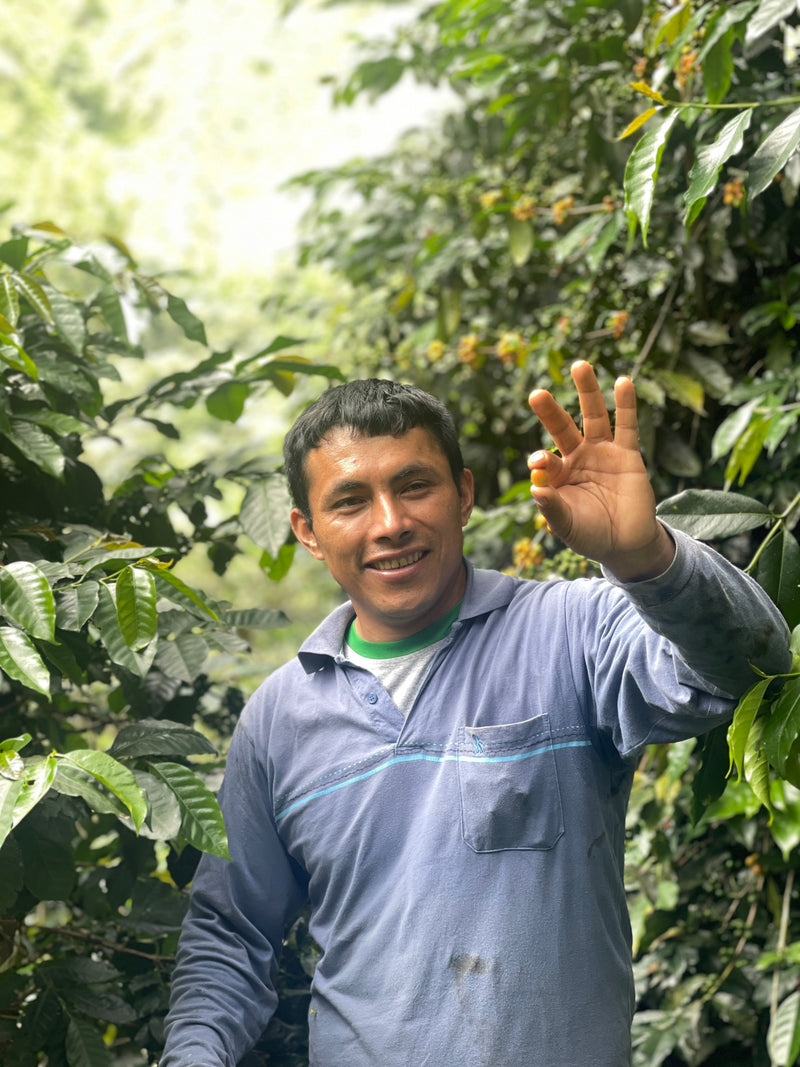
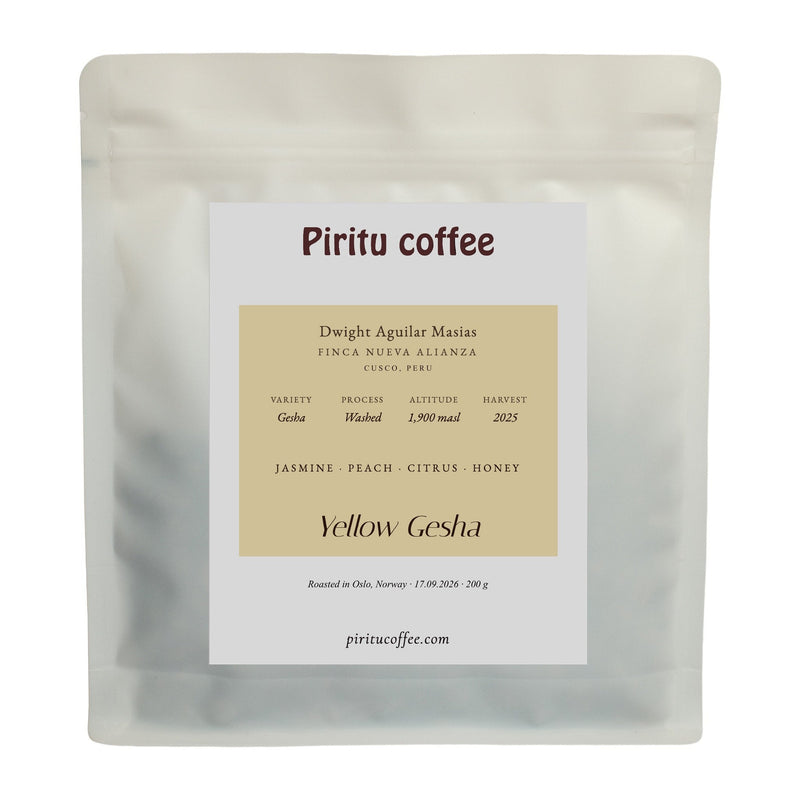
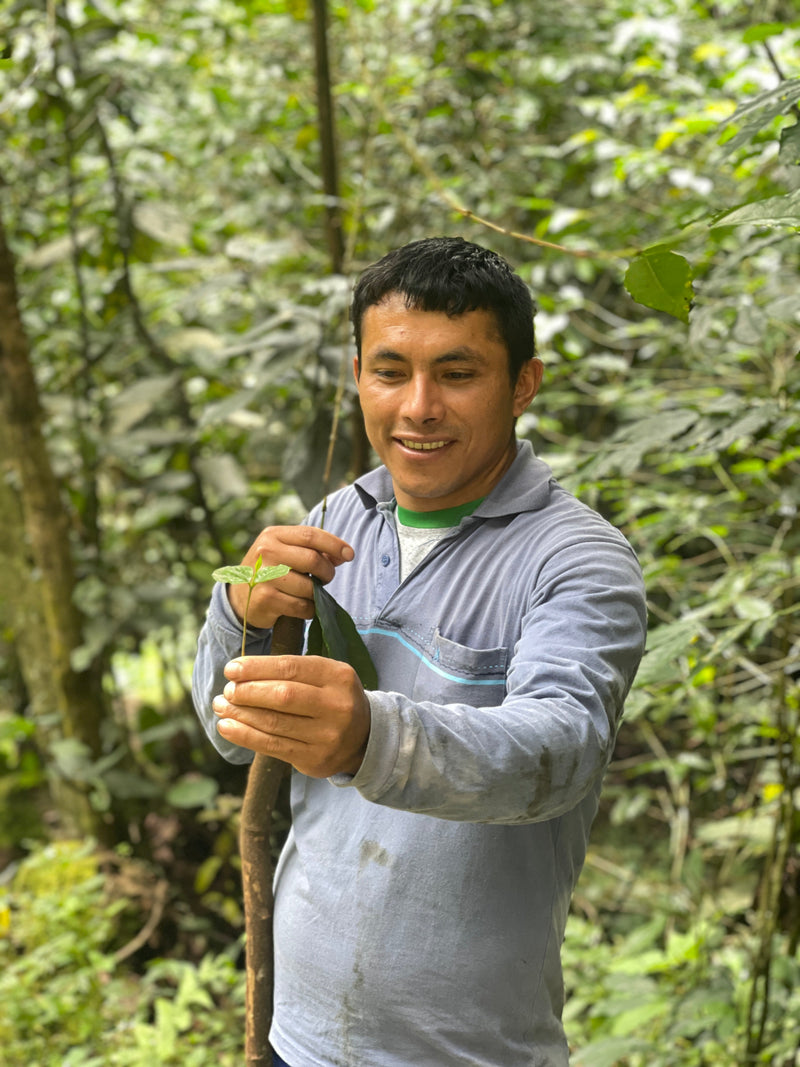
Both coffees grow on the same farm, on the same hillside in Santa Teresa, Cusco, at around 1,900 metres. Both are picked by the same team, fermented the same way and dried on the same raised beds. Dwight Aguilar Masias treats them identically from the tree to the sack.
And yet they do not taste the same. One is round and generous, the other lighter and more perfumed. The difference is the tree, and it starts with the colour of the ripe cherry.
What Makes a Gesha Red or Yellow
Most coffee cherries turn red when they are ripe. Some trees carry fruit that ripens yellow instead. It happens in several varieties, which is why you see names like Yellow Bourbon and Yellow Catuaí, and it happens in Gesha too.
At Finca Nueva Alianza the red Gesha came first. Gesha and Pacamara were planted in 2015, and it was a washed red Gesha that won Cup of Excellence Peru for Dwight in 2018 and again in 2021. In 2020 he planted one hectare of Gesha that fruits yellow. The first bags left the farm three years later.
Nobody has published a DNA test of the yellow trees, and there is no record of where the seed came from. What we can say is that it is grown, picked and processed as Gesha, and that it cups differently from the red. We have written more about that one hectare in Yellow Gesha: One Hectare in Santa Teresa.
Same Farm, Same Process
This is what makes the comparison useful. The cherries are picked by hand at full ripeness and rested for 24 hours before floating, which removes anything underripe or damaged. They are de-pulped and dry-fermented for 36 hours, then dried on raised beds under shade for around 20 days, until the beans reach roughly 10 percent moisture.
That is the same for both. When two lots share the altitude, the soil, the pickers, the fermentation and the drying, whatever is left over in the cup comes from the tree.
In the Cup
Red Gesha is the round one. Jasmine and lychee, honeydew and stone fruit, with bright citrus and a long honey finish. It has weight in the mouth.
Yellow Gesha is lighter and higher. Jasmine and lilac up front, then soft melon and ripe peach, with a citrus edge that keeps it from turning sweet. The finish is honeyed but clean, and the peach comes forward as the cup cools.
If you like tea and florals, the yellow is the one. If you want body, take the red.
Side by Side
| Red Gesha | Yellow Gesha | |
|---|---|---|
| Farm | Finca Nueva Alianza, Santa Teresa, Cusco | Finca Nueva Alianza, Santa Teresa, Cusco |
| Altitude | Around 1,900 m | Around 1,900 m |
| Cherry colour | Red | Yellow |
| Planted at the farm | 2015 | 2020, one hectare |
| Process | Washed, 36 h dry fermentation, raised beds | Washed, 36 h dry fermentation, raised beds |
| In the cup | Jasmine, lychee, honeydew, stone fruit, honey | Jasmine, lilac, melon, ripe peach, citrus, honey |
| Body | Rounder, fuller | Lighter, more tea-like |
| Cup of Excellence at the farm | Dwight's washed Gesha won in 2018 and 2021 | The farm's yellow Gesha placed 5th in 2025, 89.86 points |
| Our price, 200 g | 379 NOK | 419 NOK |
A note on the competition row: Cup of Excellence ranks individual lots, and the winning lots are sold at auction. Our bags come from the same farm and, for the yellow, the same harvest that placed fifth, but they are not the auction lots themselves.
Why the Yellow Costs More
Scale. The yellow comes from a single hectare planted in 2020. What Dwight does not keep for competition is shared between a handful of roasters, and we get a few sacks. Less coffee, same work, higher price.
Which One Should You Choose?
- Choose the Yellow Gesha if you drink your filter black and slowly, and you want florals and fruit above everything else.
- Choose the Red Gesha if you want a Gesha that is generous and round, with more sweetness and body.
- Choose both if you want to taste what the tree does on its own. Brew them side by side with the same recipe and the difference is easy to find.
Brewing Them Side by Side
Use the same recipe for both, so that the coffee is the only variable. We brew 14 g of coffee to 250 g of water at 91 °C on a V60: bloom with 45 g for 30 to 40 seconds, pour to 155 g, then to 250 g, and aim to finish between 2:30 and 3:00. Let both cups cool for a few minutes before you compare them. Our full method is in How to Brew Gesha on a V60.
Frequently Asked Questions
Is Yellow Gesha a different variety from Red Gesha?
Probably not, but it has not been tested. It is grown and processed as Gesha, and the visible difference is the colour of the ripe cherry. In the cup it is lighter and more floral than the red.
Which is better, Red or Yellow Gesha?
Neither is better. The yellow is more delicate and perfumed, the red is rounder and sweeter. It depends on what you like in a cup.
Did the Yellow Gesha win Cup of Excellence?
The farm's yellow Gesha placed fifth in Cup of Excellence Peru 2025 with 89.86 points, listed as "Geisha Amarilla". Our Yellow Gesha comes from the same farm and harvest, but it is not the auction lot.
Why is Yellow Gesha more expensive?
There is much less of it. At Finca Nueva Alianza it grows on a single hectare planted in 2020.
Can I brew Red and Yellow Gesha the same way?
Yes. We use the same V60 recipe for both, 14 g to 250 g at 91 °C, which makes them easy to compare.
Try Them Yourself
Both coffees come from Dwight Aguilar Masias at Finca Nueva Alianza, Santa Teresa, Cusco, roasted to order in Oslo and shipped within 24 hours of roasting.
- Yellow Gesha (200 g). Jasmine, peach, citrus, honey.
- Red Gesha (200 g). Floral tea, stone fruit, citrus, honey.
- Tres Amigos de Cusco. One bag each of Yellow Gesha, Red Gesha and SL09 Inca, with free shipping.