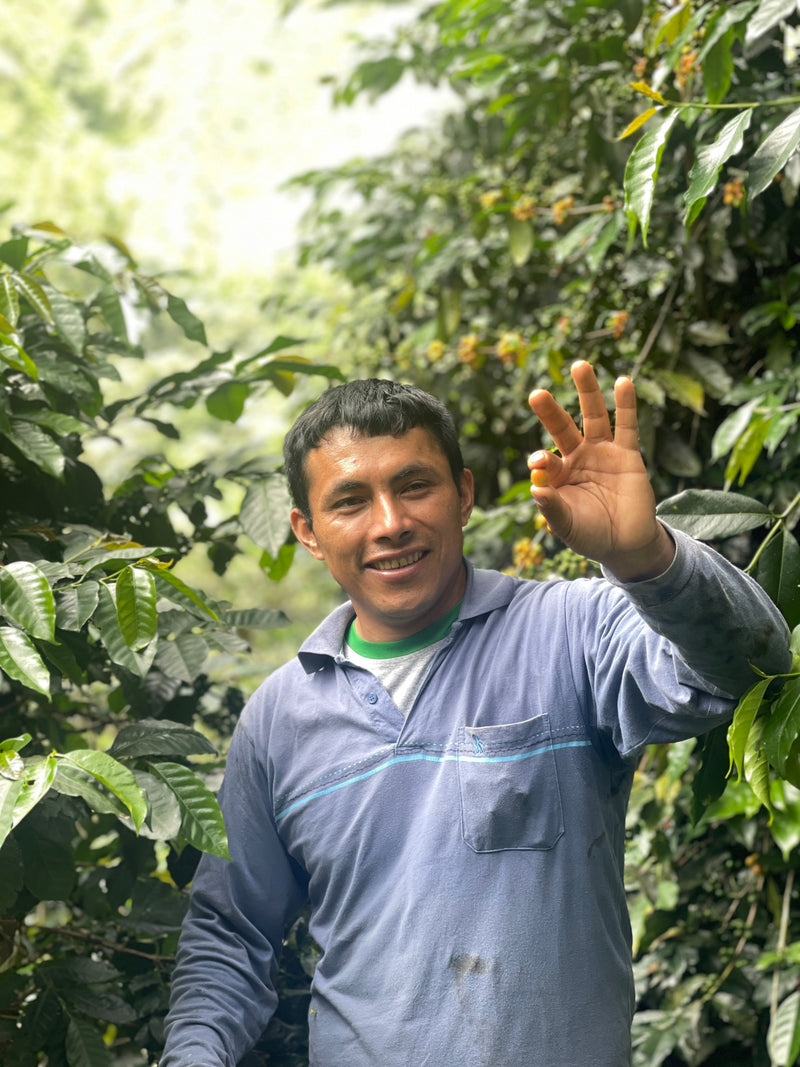
Yellow-fruited coffee cherries. Photo: eli hirtzel, Unsplash.
In 2020, Dwight Aguilar Masias planted one hectare of Gesha that fruits yellow instead of red. He already had two Cup of Excellence titles. He did not need another variety.
Three years later, the first bags left the farm. In November 2025, that yellow Gesha placed fifth in Peru's Cup of Excellence, listed in the results as "Geisha Amarilla". It is the first time the name appears in the competition record.
This is what we know about it, and what we do not.
The farm
Finca Nueva Alianza sits in the Santa Teresa district of La Convención, Cusco, on the right bank of the Vilcanota river, downstream from Machu Picchu. Dwight's parents, Timoteo Aguilar Ramos and Belarmina Masias Zavala, started it in 2000 with five hectares. Today it is thirty, of which eight are coffee. Dwight is the third generation of his family to grow it.
The coffee grows on terraces at a 45 percent slope, between 1,800 and 1,950 metres, in sandy loam. Sixty percent of it is under shade. The shade trees are avocado, pacae, banana, pumarosa, lemon, orange and tangerine. The farm gets around 1,300 mm of rain a year and produces roughly 213 exportable bags of 69 kg.
For most of its life it grew ordinary coffee. Specialty varieties came in 2010. Gesha and Pacamara were planted in 2015.
Two titles, then a third generation of trees
Peru held its first Cup of Excellence in 2017. In 2018, the second edition, Dwight's washed Gesha scored 91.08 and won. The lot sold at auction for 45.10 dollars a pound.
In 2021 he won again, with a washed Gesha at 90.20. Nobody in Peru had done that before. At the ceremony he said: "I know all the work that was done over the year: fertilization, harvesting, not sleeping, working 24 hours. Thanks to coffee, I'm a champion again."
He placed ninth in 2023. Then in 2025, fifth, with the yellow one.
That is the context for the one hectare. A producer with two national titles and a settled reputation for red Gesha chose to plant something with no track record, wait three years for the first harvest, and enter it in competition against his own red.
What Yellow Gesha is
Gesha is the variety collected from forests near the village of Gesha in southwestern Ethiopia in the 1930s. It reached Panama in the 1960s and became famous in 2004. We have written about that history elsewhere.
Yellow Gesha is the same variety with yellow cherries. Yellow-fruited mutations are well known in arabica. Yellow Bourbon appeared in Brazil in the 1930s and is now grown widely. Yellow Caturra and Yellow Catuai exist for the same reason. Somewhere along the line a plant produces yellow fruit instead of red, someone notices, and if the cup is good, they propagate it.
Where Dwight's yellow trees came from is not documented anywhere we can find. SEY Coffee in Brooklyn, who also buy from him, write that he is widely considered the first to cultivate it, and they put an asterisk on the name. We think that is the right level of confidence. He is the first producer we know of to grow it, sell it and enter it in competition. Whether the mutation started on his farm or arrived as a seedling from somewhere else, nobody has said.
What the 2025 results show is that the international jury accepted "Geisha Amarilla" as a variety name and scored it 89.86, level with the best red Gesha from Cusco that year (Corralpampa, also 89.86) and ahead of the rest.
What it tastes like
Dwight grows both. Side by side, the difference is not subtle.
The red is round. Jasmine and lychee, honeydew, stone fruit, a long honey finish. It has weight.
The yellow is lighter and higher. Jasmine and lilac up front, then soft melon and ripe peach, with a citrus edge that keeps it from going sweet. The finish is honeyed but clean. Other roasters who buy the same coffee describe orange blossom and passion fruit, and one of them compares the acidity to Champagne. We would not go that far, but we understand why they do.
If you like tea and florals, this is the one. If you want body, take the red.
How it is processed
The cherries are picked by hand at full ripeness and rested for 24 hours before floating, which removes anything underripe or damaged. They are de-pulped and dry-fermented for 36 hours, then dried on raised beds under shade for around 20 days until the beans reach roughly 10 percent moisture.
That is the same process Dwight uses for the red. The difference in the cup is the tree, not the tank.
Where ours comes from
Our Yellow Gesha comes from Finca Nueva Alianza, from the November 2025 harvest. That is the harvest the jury cupped in the first week of November, and the one that placed fifth. Our bags are not the competition lot itself, which was sold at auction, but the same farm and the same harvest.
One hectare does not go far. What Dwight does not keep for competition is split between a handful of roasters, in Brooklyn, Da Nang and Oslo. We get a few sacks. When they are gone, the next ones are a year away.
Brewing
Light roast, for filter. The florals are delicate and do not survive heavy extraction.
V60 or Kalita Wave. 14 g of coffee to 250 g of water at 91 degrees. Bloom with 45 g for 30 to 40 seconds, pour to 155 g, then to 250 g. Aim for 2:30 to 3:00 total. The full method, with tips, is in How to Brew Gesha on a V60.
Let it cool. The peach comes forward as the cup drops below 60 degrees.
Frequently asked questions
Is Yellow Gesha a different variety from Gesha?
Probably not, but it has not been confirmed. The working assumption is a yellow-fruited mutation of Gesha, in the same way Yellow Bourbon is Bourbon, and the Cup of Excellence lists it as Geisha Amarilla. SEY Coffee, who also buy it, note that the lots have not yet been genetically confirmed to be Gesha and that samples have been submitted for testing.
Who was first to grow it?
Dwight Aguilar Masias at Finca Nueva Alianza is the first producer we know of to cultivate, sell and compete with it. Where the original plant material came from is not documented.
Did this coffee win the Cup of Excellence?
Dwight has won Peru's Cup of Excellence twice, in 2018 and 2021, both with washed red Gesha. The farm’s Yellow Gesha competition lot placed fifth in 2025, scoring 89.86, and was sold at auction. Ours comes from the same farm and the same harvest, but it is not that lot.
How much of it exists?
One hectare was planted in 2020. Dwight has said he plans to expand it. For now, a hectare of Gesha at 1,900 metres yields a few hundred kilos of green coffee a year, split between a handful of buyers.
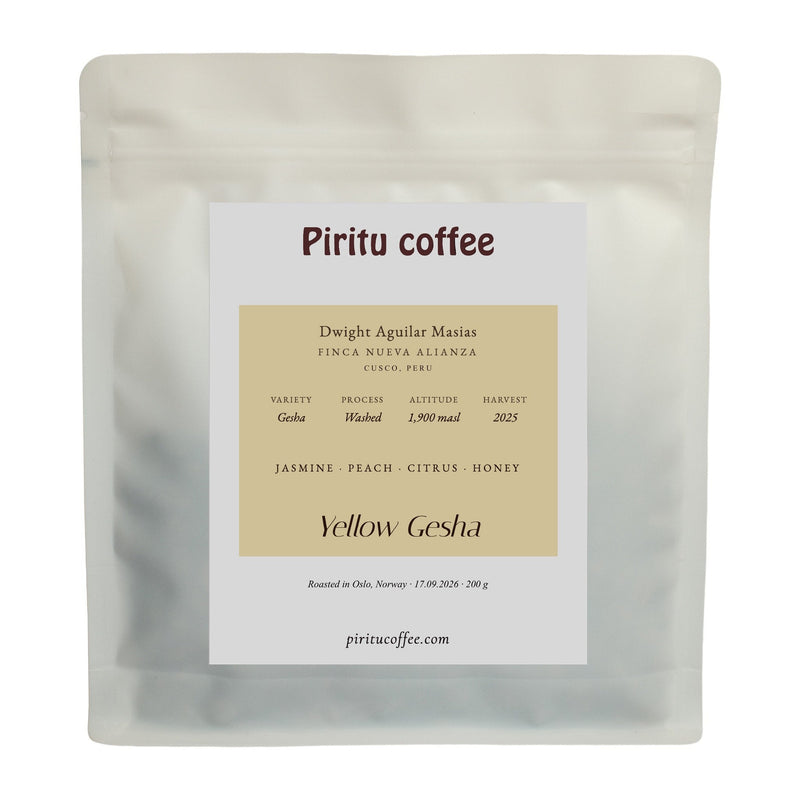
Yellow Gesha Microlot, 200 g. Jasmine and lilac, melon, ripe peach, citrus, honey. Roasted light in Oslo, to order.
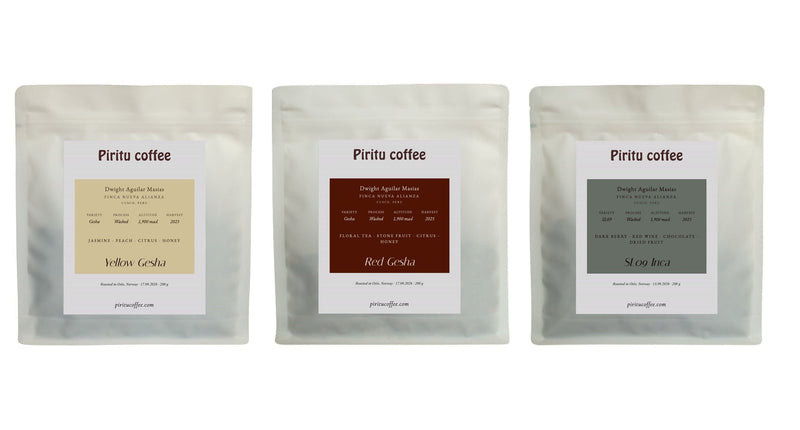
If you want the red for comparison, or the SL09 for something that is not a Gesha at all, they are on the same shelf.
Written by Giovanni Lindblom, co-founder of Piritu Coffee. Sources: Alliance for Coffee Excellence results for Peru 2018, 2021, 2023 and 2025; Daily Coffee News, November 2021; XLIII Coffee and Onyx Coffee Lab producer pages; SEY Coffee.